
European sea bass
Bar franc, Loubine - Dicentrarchus labrax - Moronidae
Identification
The Mediterranean “loup” and the Atlantic “bar” are one and the same! Even though the former is on average stockier and the latter more slender (currents will do that!), they really are the same species, not two subspecies. Athletic and streamlined, this lord of open water has silvery flanks and a gray back with blue-green highlights.
| Size | Weight | |
|---|---|---|
| Common adult | 60 to 90 cm | 5 to 8 kg |
| Maximum adult | 110 cm | 16 kg |
| Legal size | Legal weight | |
| English Channel | 42 cm | - |
| Atlantic | 42 cm | - |
| Mediterranean | 30 cm | - |
| Usual depth | Extreme depth | Best search area |
|---|---|---|
| 1 to 30 m | 90 m | 1 to 15 m |

Scientific notes / Biology:
The sea bass is a predatory fish that feeds on small fish, crabs and shrimp.
Its life expectancy can reach 15 years in the Mediterranean (although few specimens seem to live beyond 6 or 7 years along that coastline) and around twenty years in the English Channel and the Atlantic, where it apparently lives longer (in captivity – in aquariums – a lifespan of 30 years has been observed).
Sea bass are gonochoric: each fish is born male or female and does not change sex during its life. Growth is correlated with water temperature, which explains why, at the same age, Mediterranean bass are larger than Atlantic bass. In the Atlantic, males reach sexual maturity between 4 and 7 years (32 to 37 cm) and females between 5 and 8 years (33 to 42 cm). In the Mediterranean, males mature between 2 and 3 years (23 to 30 cm) and females between 3 and 5 years (31 to 40 cm). Females therefore start breeding later. This is why most fishing federations recommend an ethical minimum catch size of 42 cm, so that every fish has spawned at least once.

Spawning takes place from around mid-December to the end of February in the Mediterranean, and from January to April in the Atlantic (even until mid-May on the coasts of northern Brittany). Spawning grounds are often found at around ten meters, on characteristic bottoms: large vertical cracks, big rocks with an arch or full of holes, and channels of coarse gravel. There are spawning grounds all around the Mediterranean, in the Atlantic and in the English Channel (in northern Brittany, probably in Normandy but, as far as we know, none in Hauts-de-France). Females release eggs 1 mm in diameter, which hatch after 4 to 7 days.
There are several “populations” of this Moronidae, in the English Channel, the Atlantic and the Mediterranean. Scientific studies on the movements of these large groups of fish and the interactions between them are almost nonexistent, but a few recent tagging programs suggest that exchanges do take place, at least between the Channel and Bay of Biscay “stocks”.
Where to find it
Sea bass are found along the entire French coastline, from Hauts-de-France to Corsica, with concentrations varying from one area to another.
They thrive in a wide variety of environments. They tolerate changes in salinity well, from 0.5% to 40% (for reference, seawater averages 35%), and therefore like the brackish waters of river mouths (Loire, Gironde, Rhône…) and the lagoons of Languedoc-Roussillon (Leucate, Thau…), the Bouches-du-Rhône (Berre) and Corsica.
They are particularly fond of large sandy areas with turbid water, preferably swept by currents, such as the Bay of the Seine (Calvados), Vendée and Charente-Maritime, the Landes, Languedoc and the eastern plain of Corsica.
This coastal fish also likes to feed, rest and breed over rocky areas and seaweed beds (Posidonia, kelp, sargassum).
Rock slabs, boulders offering shelter and above all wrecks are also very popular with sea bass, which take refuge there, sometimes in large numbers. On the other hand, the species is sensitive to changes in water temperature. Below 10°C it is usually absent and, conversely, it does not cope well with warm water above 24°C. It also seeks out well-oxygenated water and will often be found in the foam along rocky reefs or in the breaking waves along beaches.
Frequency of encounters
In the Mediterranean and, to a lesser extent, on the Basque coast in the Atlantic, sea bass can be seen all year round, whereas elsewhere in the Atlantic and in the English Channel they are mainly present along the coast from early May to late October (or late November, and even a little later if the autumn weather is very mild).
In the Atlantic and the Channel, sea bass gather along the coast in the fall (around November) before heading offshore to spend the winter at depths of 20 to 40 m, sometimes a little more, where temperatures are more stable. In spring, when the water warms up (from 10°C), the bass move back toward the coast, first onto offshore banks, then spread out along the whole coastal strip (once the water exceeds 12°C) and stay there all summer until mid-fall. These six months of the warm season are therefore when spearfishers are most likely to come across them.
In the Mediterranean, the high season for spearfishing coincides with the winter spawning period (mid-December to late February). The fish then leave the lagoons and gather along the coast in small groups (called “compagnes”), usually made up of one large female surrounded by a few smaller males. In March comes the “repasse”: the fish return to the lagoons or scatter along the coast, where they can travel a great deal. Spearfishers can therefore meet them in winter on the spawning grounds and, more randomly, in summer in favorable areas where the bass come to feed.
Hunting techniques
Every hunting technique can be used depending on the circumstances: region, season, tidal phase and current (in the English Channel and the Atlantic) and habitat. Though wary, the sea bass also has a predator’s natural curiosity, and its behavior is inconsistent, even whimsical.
Although it is considered a pelagic (open-water) fish, near the coast it often moves along sandy or rocky bottoms and readily settles inside natural or man-made cavities, so it is mostly near the bottom that you will hunt it.
In open water, the technique of choice is the agachon (ambush on the bottom). Simply diving down and settling into position is often enough to attract the fish in the area. Many spearfishers also lure bass with small sounds (throat noises, scratching the rock, tapping the speargun butt against the rock, vibrating the bands, stirring up sand), which the fish can hear up to twenty meters away. Conversely, a noise that is too loud (a weight knocking or a fin scraping the rock) can scare off a fish or a school for good. If the fish are there, they will approach quickly, within 5 to 30 seconds. Waiting any longer is usually pointless. You should also avoid body movements (such as turning your head from side to side), which make the fish wary, limit their approach and can prompt them to flee. Hiding in seaweed or blending in along a rock feature is a real advantage and will bring the fish in fast and close. The agachon is very well suited to the Mediterranean, where hunting from a fixed position also helps you stay partly out of sight of the fish in often clear water. In the English Channel and the Atlantic, this technique works best when the tide turns (about 1 to 1.5 hours after low-water slack, then during the flood when the tidal current is at its strongest), because the fish are moving and hunting again and come in easily. A 100 cm speargun with a reel and a Tahitian shaft is a suitable weapon.
Drift fishing in the current also works very well in the English Channel and the Atlantic because, here again, the fish are very active and in predation mode. Dive down, spot a promising rock feature, reach it with an “indienne” (a slow stalk along the bottom), ideally carried by the current, and stay there waiting for the fish, which in these conditions can very quickly come within range.
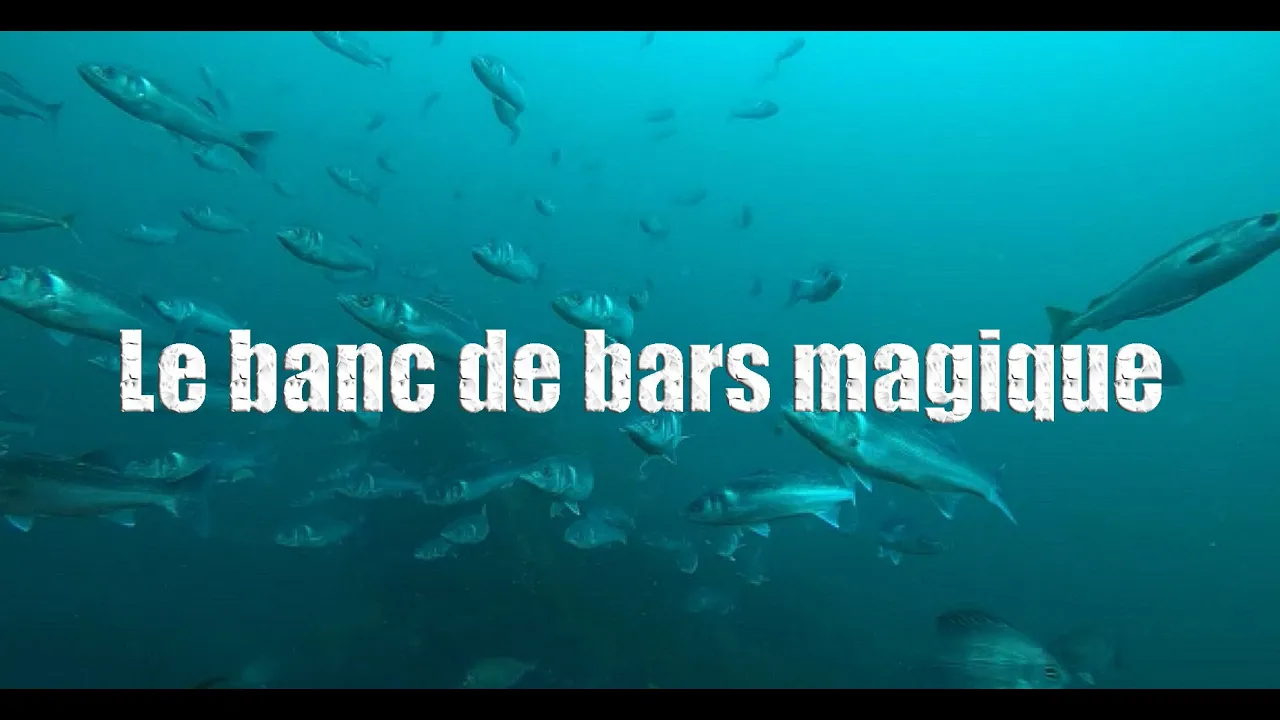
In wrecks (ships, pontoons) and under “stones” (slabs or rocks with a deep, dark shelter and at least two entrances), sea bass settle in alone, in small groups or sometimes in large numbers when the structure allows it. Hole hunting is then the method to use, with a 75 to 90 cm speargun with a reel and a sturdy trident (Matc type), to pin the fish with a shot to the head or the front third of the body and then pull it out easily. This method works in the Mediterranean but also in the English Channel and the Atlantic, at low tide (shallower water, and bass more often holed up) or when the water is very clear (the fish more often “settle in” under these sea conditions).
The indienne can be used in shallow water (along a cliff or through kelp beds), moving very slowly, and lets you surprise, from the surface or a few meters down, a fish feeding against the rock or settled in the seaweed, resting or digesting. It is a technique well suited to low tide in the English Channel and the Atlantic, when sea bass are moving little.
The coulée (a silent descent onto the fish) is used more rarely and opportunistically, gliding down silently onto a lone bass moving slowly, or onto a school circling just above the sand or in open water. In the latter case, always stay above the fish (to avoid making the school dive or disappear) and shoot the individuals that rise to meet you.
Photo and video galleries


Preparation tips
One of the most sought-after fish, prized for its flesh. Grilled on the barbecue, baked in a salt crust, as fillets… it works every way!
